
- calendar_today August 20, 2025
.
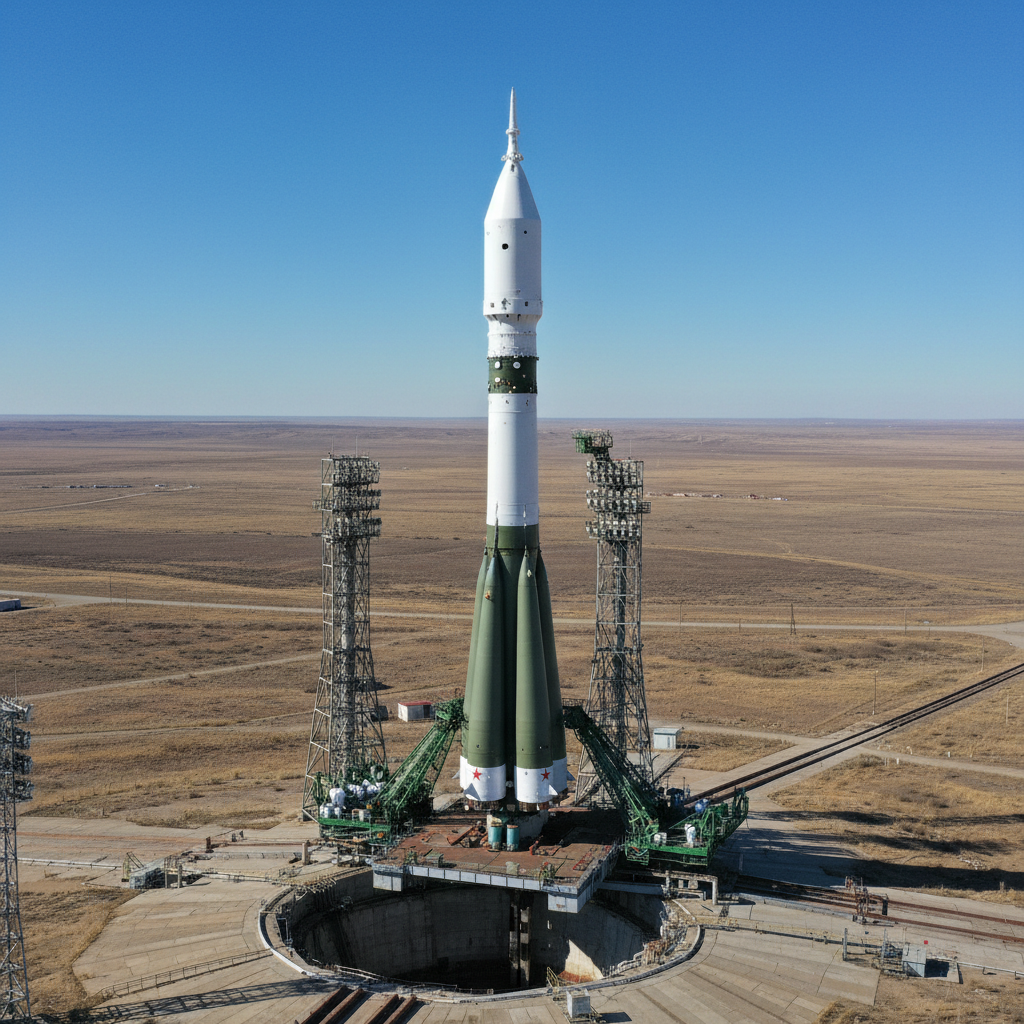
Russia is gearing up for the maiden launch of its next-generation Soyuz-5 rocket before the end of this year. Dmitry Bakanov, the director of Roscosmos, Russia’s state space agency, announced as much in an interview with state news agency TASS earlier this week.
“Yes, we are preparing for December,” he said. “The preparations for the first flight are practically ready.” The Soyuz-5 is set to launch from the Baikonur cosmodrome in Kazakhstan. If all goes to plan, that launch would be the first test flight of a rocket that has been in development for over a decade. Roscosmos may perform several tests of the launcher before entering service, which it does not expect to occur until 2028.
Roscosmos inherited the Zenit-2 rocket from the Soviet era. This launcher design was first proposed in the 1980s by Yuzhnoye, a Ukrainian rocket design bureau. Zenit rockets were manufactured in Ukraine, but they used RD-171 engines made by Roscosmos. The Zenit was an example of post-Soviet aerospace collaboration between the two countries. Relations between Russia and Ukraine rapidly deteriorated following Russia’s invasion of Ukraine in February 2022. In late 2023, Russia bombed the very plant in Ukraine that once assembled Zenit rockets.
Soyuz-5 is an enlarged Zenit, but one that has been entirely manufactured in Russia. The redesign has largely eliminated Ukraine from the supply chain. As far as key components are concerned, all hardware will be sourced domestically. In that way, Moscow’s decision to boycott Zenit has a silver lining. It ends years of reliance on foreign suppliers while simultaneously phasing out the country’s second flagship rocket, Proton-M.
A Bridge to the Future
Soyuz-5 is in many ways a medium-lift launcher. It will be able to lift about 17 metric tons into low-Earth orbit, a capacity afforded by slightly larger propellant tanks when compared to Zenit. The heart of the rocket is the RD-171MV, the latest iteration of a family of engines with a long history.
The design can trace its origins back to the Energia rocket program of the 1980s, which was developed to power the Soviet Union’s short-lived space shuttle Buran. The latest version, the RD-171MV, has one key distinction: it does not use any parts from Ukraine. The engine burns a kerosene/liquid oxygen combination to produce more than three times the thrust of the Space Shuttle main engine. As a result, the RD-171MV is the most powerful liquid-fueled rocket engine in service.
That is not the case with Soyuz-5 itself, however. This is an expendable launcher in an industry in which many competitors are building toward reusability. The first stage of SpaceX’s Falcon 9, for example, is intended to land back on Earth so it can fly again. That design distinction likely rules out Soyuz-5 from an international launch market it may once have had a significant share of.
The rocket has other functions, however, even if Roscosmos never sells launch services on the scale it once could. Space remains a priority for the Kremlin, but the war in Ukraine and resulting international sanctions have taken a toll on state budgets. It has also made it difficult for Roscosmos to develop a brand-new, reusable rocket from the ground up. The Amur, also known as Soyuz-7, is a rocket designed for this purpose. Featuring a reusable first stage and methane-fueled engines, Amur could theoretically compete with SpaceX on cost. So far, however, the rocket has fallen victim to repeated delays. As a result, Roscosmos has pushed back its maiden flight to at least 2030.
Soyuz-5, in a sense, serves as a stopgap to the even longer wait for Amur. It is a way to keep Russia’s space program moving forward with something better than Proton-M, even if that “something” is technologically speaking still stuck in the Soviet past.
The commercial side is a different story. International launch services have changed dramatically in the last 10 years. SpaceX in particular has reshaped the market with cheaper, more flexible rockets, just as Chinese launch providers have done in their home market. Russia is now manufacturing Soyuz-2 rockets for crewed missions and the Angara family for heavier payloads, but it has not managed to crack either one of those two niches internationally. Soyuz-5 may be able to change that trend, but its newness and expendability cast doubt on whether it can.
It is something of a nonstarter for the launch market. But the fact that Roscosmos has at least brought Soyuz-5 close to flight given the current environment is a testament to the program. December’s launch would serve to prove that Russia can still field new launch hardware under sanctions and difficult economic circumstances.
Soyuz-5 is in many ways old technology. It is not a technological leap forward. But in the current context, the rocket has value nonetheless. It is a statement of self-sufficiency that lets Russia reduce its reliance on foreign technology. It also is a bridge to a more promising future, be that represented by Amur or some other design that may be further down the road.


