- calendar_today August 10, 2025
LA’s Museum of Marvels Calls for Help After Fire
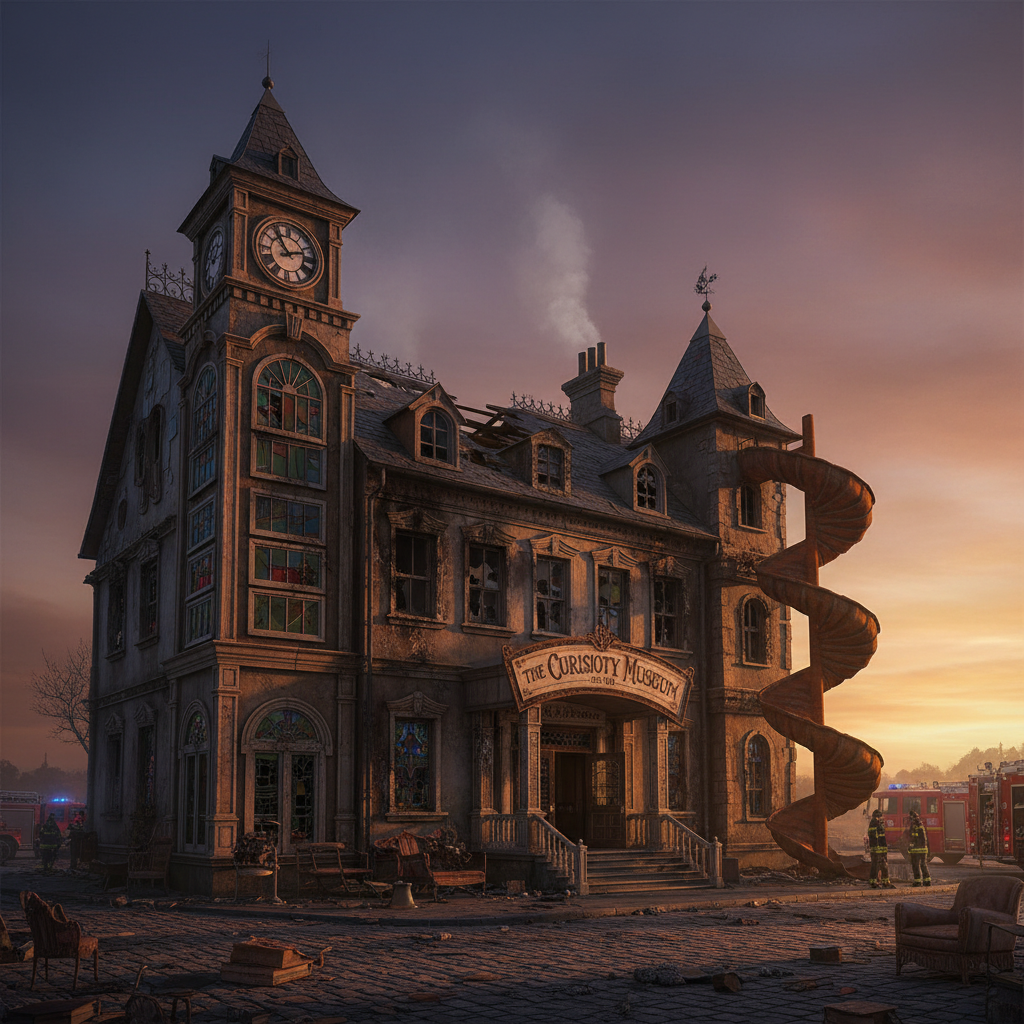
A bizarre Los Angeles institution, the Museum of Jurassic Technology, has recently been affected by an unusual accident: a nighttime fire that has caused damage to the museum’s building. Occurred earlier this month, on the night of July 8, the blaze destroyed the museum’s gift shop, and the smoke damaged other exhibits throughout the facility. The museum estimates that it has lost about $75,000 in revenue so far, while the expected reopening is planned for next month.
The Museum of Jurassic Technology, as the name may suggest, bills itself as a “museum dedicated to the advancement of knowledge and the public appreciation of the Lower Jurassic.” But the Museum of Jurassic Technology (MJT), located in Culver City, has very little to do with any dinosaur-era fossils or artifacts. It takes its cue from the wunderkammer, early iterations of museums during the Renaissance, which were known as cabinets of curiosity. Since it opened its doors to the public in 1988, the MJT has maintained a somewhat cult status among LA’s peculiar cultural sites, due to its fascination with the bizarre and the deceptive.
Founded by David Hildebrand Wilson and Diana Drake Wilson, and led by David Wilson since Diana died in 2015, the MJT has been popular with the public and has attracted a good number of visitors since it opened in 1988. But even more unusual than its exhibits are how the museum likes to tell its stories, which have made the museum a more underground favorite in Los Angeles. Many of its objects are based on fact. But the museum weaves its narratives of those facts to create exhibits that are both eerie, subversive, and unusual, often making visitors unsure of what is true and what is false. One permanent exhibit highlights the fantastical work of Athanasius Kircher, a historical 17th-century polymath, Jesuit priest, and universal genius. The work of Armenian-American artist Hagop Sandaldjian is also prominently featured in the MJT, as his sculptures, constructed from a single human hair, are incredibly small. They are so small that they must be placed inside the eye of a needle to be displayed.
The museum has continued to hone this curatorial approach to subversive storytelling, with other exhibits which include decomposing dice from magician Ricky Jay, an elaborate visual history of trailer parks in the Los Angeles area called “The Garden of Eden on Wheels,” stereographic radiographs of flowers, and microscopic mosaics made from the scales of butterfly wings. One recent exhibit from the museum, titled “Dear Mr. Flaherty,” is a collection of 817 letters written by amateur astronomers to the Mount Wilson Observatory between the years 1915 and 1935. There is also a fully functioning Russian tea room, which has been part of the museum since 2005. Modeled after Tsar Nicholas II’s study in the Winter Palace in St. Petersburg, it is only one of several features which Wilson is famous for curating at the museum, each of which blurs the lines between reality and fiction, the mainstream and the avant-garde.
Fire and Damage
Author Lawrence Weschler wrote at length about the museum in 1996, in a book called Mr. Wilson’s Cabinet of Wonder, which sought to uncover the origin stories of many of the museum’s most famous pieces. And it was Weschler who detailed the events of the recent fire, in a new piece he wrote for the Art Newspaper. According to Weschler, it was David Wilson who first noticed the fire and called it to the attention of the Los Angeles Fire Department. Wilson lives in a home directly behind the museum. He noticed the flames coming from the building and ran out with two fire extinguishers, only to be greeted by “a ferocious column of flame which issued forth from its corner as if from some blast furnace,” Wilson later recounted. The fire had found its way up the corner of the museum that faces the street.
Wilson’s extinguishers proved to be too small to have much of an impact. His daughter and son-in-law had arrived moments later with a larger fire extinguisher and had been able to corral the blaze just in time, before the fire trucks even arrived. But Wilson was told later that the entire building would have been gone if firefighters had arrived just one minute later.
While the majority of the damage was to the gift shop itself, much of the smoke had spread into the rest of the museum as well. David Wilson later described the smoke damage to the museum as a process by which “a thin creamy brown liquid was evenly poured over all the surfaces—the walls, the vitrines, the ceiling, the carpets and eyepieces, everything.” Smoke damage of this sort can be particularly harmful and difficult to restore. So much so that it becomes a labor-intensive process. As a result, museum staff and volunteers have been working overtime to clean up and restore the damaged areas.
It’s an unusual setback for the MJT. And while Weschler has been seeking donations to the museum’s general fund to raise some of the lost revenue, the museum has long been a museum unlike most, one that stands apart from categories of science, art, and traditional forms of storytelling. “It is, almost beyond exaggeration, one of the most truly sublime institutions in the country,” he concluded. “We simply cannot let it go.”