- calendar_today August 7, 2025
Island Stories, New Tools: How Pacific Artists Are Using AI Without Losing Their Roots
Pacific Creatives Are Curious—But Cautious
In the islands, stories aren’t just shared—they’re passed down. Whether through chant, dance, carving, or canvas, the arts in Hawai‘i and across the Pacific are deeply personal and often ancestral. So when AI in creative work began making its way into studios and classrooms, the reaction wasn’t rejection—but it wasn’t blind excitement either.
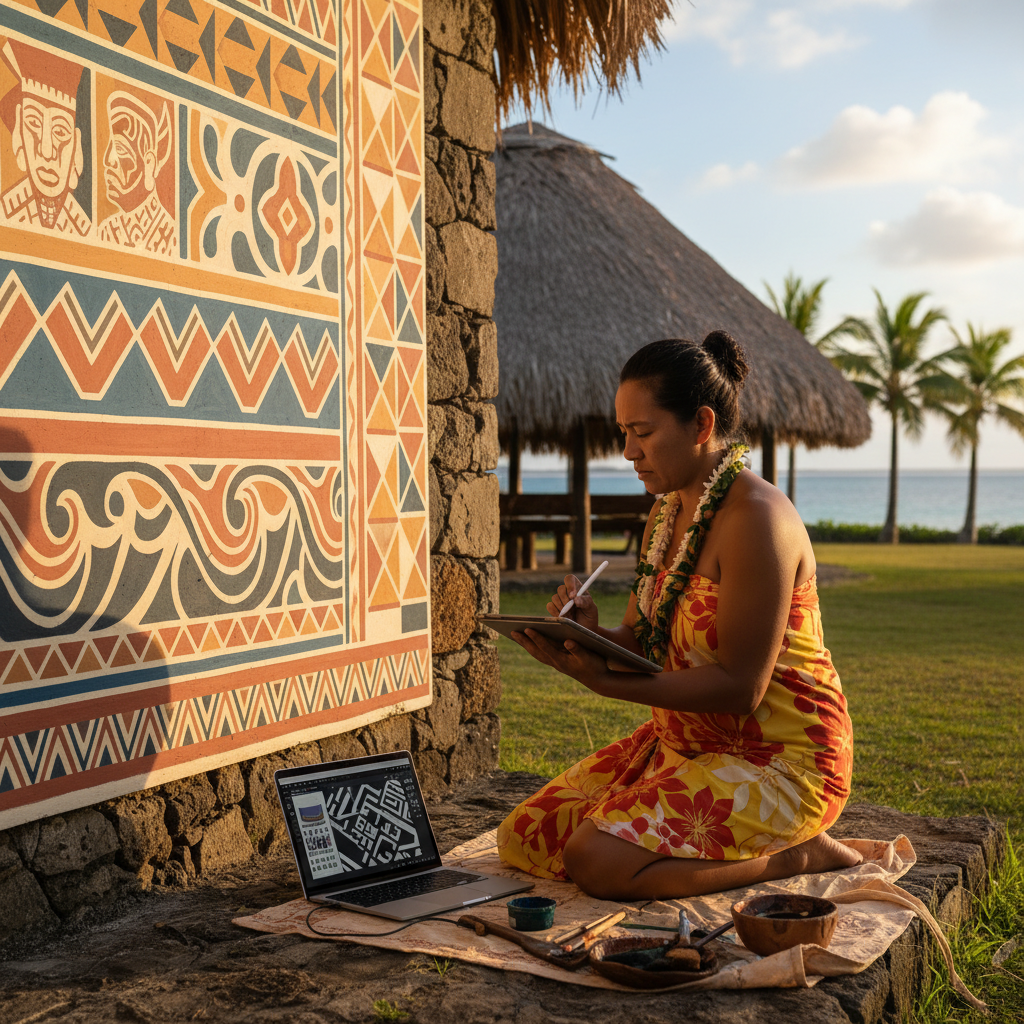
A visual artist on Oʻahu told me, “I used an AI tool once to test layout ideas for a mural. It helped with symmetry, but I’d never let it touch the story. That comes from my kūpuna.” For many Pacific creators, the line is clear: tech can assist, but it doesn’t replace lived memory or mana.
Musicians Are Exploring AI with Respect for the Source
In Hawai‘i, music is woven into everyday life—from slack key guitar to modern hip-hop, reggae, and Jawaiian beats. Some local musicians are experimenting with AI in music production, using it to test chord structures or remix sounds. But across the board, they’re keeping the emotional core human.
A beatmaker in Hilo told me, “I tried AI to loop some rhythms. Cool tool—but when I write about home, about struggle or ʻohana, I need to feel it. A machine can’t do that.” It’s a theme echoed throughout the islands: if it’s not real, it doesn’t land.
Filmmakers Are Using AI to Preserve, Not Erase
Independent filmmakers across Hawai‘i, Samoa, Guam, and beyond are beginning to use AI in filmmaking to help with logistics—like transcribing interviews in multiple languages or tagging footage. But the stories they tell? Those still come straight from the heart.
One filmmaker from the Marshall Islands shared, “I used AI to sort my footage faster, but I would never let it write the narrative. That comes from our elders.” In the Pacific, where oral history still holds immense power, tech is welcome—but only if it honors what came before.
Students Are Bridging Culture and Tech
At the University of Hawai‘i and colleges across the Pacific region, young creators are experimenting with creative technology in the Pacific Islands—merging innovation with identity. They’re designing AI-powered poems rooted in ʻōlelo Hawaiʻi, crafting interactive documentaries about migration, and building digital archives that preserve endangered languages.
A student in Guam said, “My work is about survival. AI helped with the structure, but the soul of it? That’s ancestral.” It’s a blend of future-thinking and cultural reverence that feels uniquely Pacific.
There’s Still Hesitation—and That’s Deeply Understood
Many artists in the region are choosing not to use AI at all. And here, that decision carries weight. A hula practitioner in Maui said, “You can’t rush this work. You can’t feed tradition into a computer and expect it to come out sacred.” In cultures where art is ceremony, tech can’t always find a place—and that’s perfectly okay.
How Pacific Creators Are Using AI—When They Choose To
• For early-phase planning – Layouts, sound structure, and visual sketches
• To save time – Sorting footage, generating drafts, or organizing multilingual content
• As a support tool – AI helps structure, but artists maintain control of the story
• Only when it aligns with cultural respect – AI is used intentionally, not casually
Final Thoughts
Across Hawai‘i and the Pacific, AI is slowly entering creative spaces, but not without intention. Artists here are asking hard questions: Does this honor my people? Does it support the message—or distract from it? Does it help carry the story forward, or dilute it?
For some, AI is becoming a useful tool. For others, it has no place in the process. But every decision is made with heart, tradition, and community in mind. And in this part of the world, where stories are sacred and the past walks beside the present, that’s exactly how it should be.