- calendar_today October 13, 2026
California's Evolving Approach to Wildfire Detection
On the front lines of California's wildfire defense, technology is taking center stage. Colby Nicholson, a 41-year-old senior engineering supervisor, and his team from the Alert California project are deploying advanced camera systems across the state's most fire-prone areas. Their efforts focus on early wildfire detection and improving responses to fast-spreading blazes.
Deploying a High-Tech Network
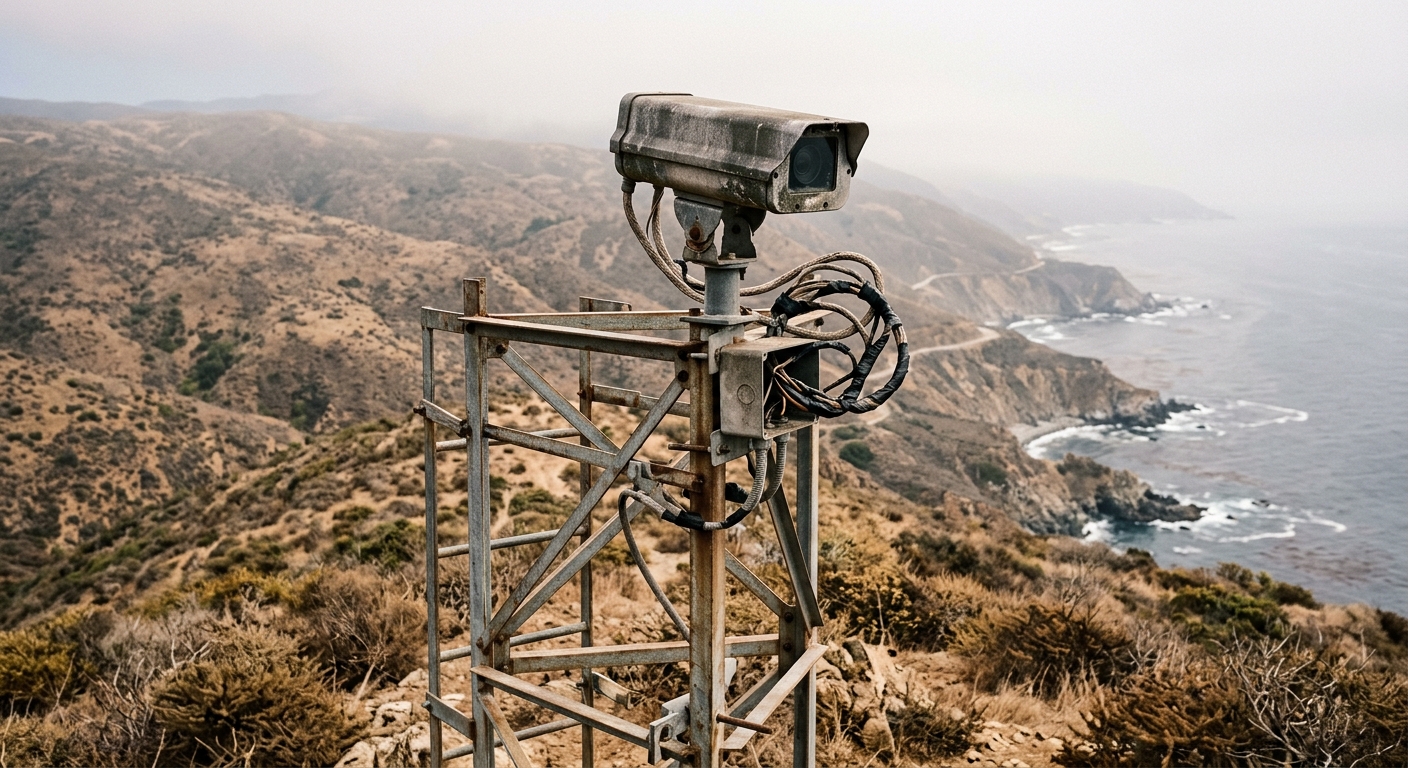
Recently, Nicholson and his colleagues installed a camera system atop a cliff 1,500 feet above Napa Valley, overlooking Soda Canyon, an area previously lacking in real-time surveillance. With each installation, the team positions a 12-foot tripod equipped with two cameras powered by solar panels and battery packs. These cameras, now part of a growing network of nearly 1,300 remote units, connect via satellite Wi-Fi to provide continuous monitoring across the state's vulnerable landscapes.
The Alert California Team in Action
Nicholson's crew, affectionately referred to as 'MacGyvers,' travels tens of thousands of miles annually throughout California. Using a Ford F-150 pickup and a van, they install and maintain cameras on diverse sites—rock ledges, mobile phone towers, rooftops, and water towers, often braving challenging terrains and harsh conditions. Team members include John Connolly, a former Marine specializing in tower climbs; Jim Conley, an experienced foreman; and Kai Erwin, the team's gofer. Leadership comes from Neal Driscoll, principal investigator at Alert California and a University of California, San Diego professor.
Integrating AI for Enhanced Wildfire Monitoring
The Alert California system leverages artificial intelligence to analyze camera feeds, often detecting wildfires before 911 calls are placed. Since 2023, this AI-driven approach has resulted in 51% of California wildfires being initially spotted by automated analysis, a figure expected to increase. The AI system provides immediate awareness, enabling fire officials to assess potential threats, determine response strategies, and deploy resources efficiently.
Real-time camera feeds are accessible to the public via the Alert California website, with time-lapse imagery and incident photos supporting emergency response coordination and information-sharing platforms like Watch Duty.
On-the-Ground Challenges and Innovations
Much of the team's work involves overcoming logistical obstacles, from driving treacherous roads to installing equipment atop remote towers and maintaining systems in the face of rough weather, wildlife, or fire damage. Camera systems are designed with redundancy: one camera performs 360-degree sweeps every two minutes, while the other can be controlled remotely for targeted views.
Impact and Expansion of Fire Surveillance
The camera network originated in 2001 to monitor seismic activity but quickly expanded after devastating events like the 2003 Cedar Fire. Investment from Cal Fire, state firefighting agencies, and utility companies has grown the network, with a current budget nearing $14 million per year. Driscoll aims to expand to 1,800 cameras, addressing more remote locations and critical blind spots at the request of local fire officials and property owners.
Firefighters credit early detection for successful, low-impact responses—the "greatest success stories are the fires you’ve never heard about," according to Falko Kuester, co-director of Alert California. Timely identification allows command centers to verify fire threats, allocate appropriate resources, and sometimes preempt larger disasters.
Looking Forward in Wildfire Response
As California continues to face severe wildfire risks, the integration of advanced technology, skilled field teams, and AI-enhanced monitoring is playing a fundamental role in fire risk reduction. The system's open-source approach enables widespread coverage and information sharing, positioning California at the forefront of wildfire camera surveillance and firefighter technology.
Source: westhawaiitoday.com.